
Article
DLSS 5 and the Fight for Gaming’s Soul
Sep
Nvidia’s next-generation neural rendering tech promises Hollywood-grade visuals, but it’s forcing an uncomfortable question about who actually owns a game’s look.
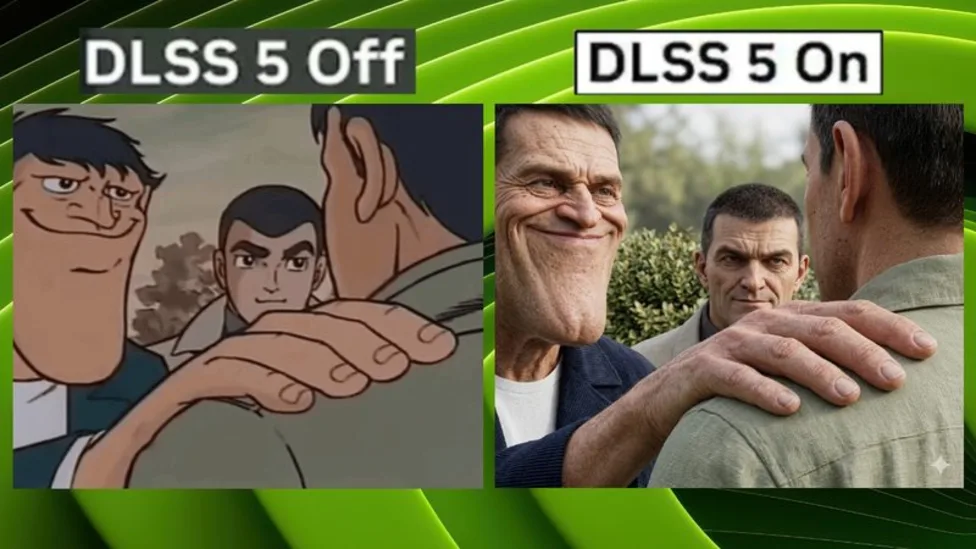
When Nvidia unveiled DLSS 5 at GTC 2026, CEO Jensen Huang called it “the GPT moment for graphics.” That’s a bold claim, even for Nvidia, but the technology backing it up is genuinely new. Unlike earlier DLSS versions, which upscaled resolution or generated in-between frames, DLSS 5 introduces a real-time neural rendering model that reinterprets a scene’s lighting, materials, and shading on the fly, infusing rendered pixels with the kind of photoreal detail previously reserved for pre-rendered Hollywood VFX. Nvidia says developers keep granular control, building masks around individual objects or entire categories (foliage, skin, fabric) and dialing the effect’s intensity up or down scene by scene. Crucially, the company insists DLSS 5 never touches a scene’s underlying geometry; it’s reworking how light and surfaces are rendered, not what’s actually there.
On paper, that sounds like exactly what artists want: more fidelity, more control. In practice, the reveal set off one of the messiest debates in recent PC gaming memory.
The Yassification Backlash
The flashpoint was Grace Ashcroft, the protagonist of Resident Evil Requiem. Nvidia’s own before-and-after comparisons showed her face smoothed, brightened, and stripped of the small imperfections Capcom’s artists had deliberately built in. Gamers online started calling it “yassification,” and the backlash was swift enough that it became the dominant story of the announcement, overshadowing the actual technical leap. Adding fuel to the fire, reporting suggested that developers at Ubisoft and Capcom were shown only limited previews of how their own games would look before the demos went public, raising uncomfortable questions about consent and authorship. Huang pushed back hard, calling critics “completely wrong” and insisting studios retain full artistic control. Whether that control feels real once a technology is baked into the pipeline of 750-plus supported titles is a separate matter.
Who Gets to Decide the “Intended” Look
That tension is exactly what PCWorld’s Alaina Yee zeroed in on, floating the idea of a “Developer’s Intended Experience” mode, a settings toggle that would let players choose between a studio’s original vision and Nvidia’s neural-rendered version. It’s an appealing idea, but Yee’s own reporting undercuts it: most studios are already stretched thin, and few will spend scarce development time hand-tuning a mode most players won’t use. There’s also a harder economic reality underneath the artistic one. As GPU prices climb and games chase increasingly photorealistic targets, fewer players will have the hardware to run anything without upscaling assistance at all. A “raw and unfiltered” toggle is a luxury that assumes you can afford to turn performance features off in the first place.
That’s the real story hiding inside the DLSS 5 backlash. This was never purely a debate about AI slop versus hand-crafted art; it’s a preview of who gets to make aesthetic decisions in an industry where the rendering pipeline itself is increasingly generative. Nvidia’s own selling point is “controllability,” but control is only as meaningful as the incentives behind it, and few publishers are likely to prioritize preserving a director’s specific vision over a technology that makes their game look more expensive for free.
What This Means Going Forward
DLSS 5 arrives this fall on RTX 50-series cards, and early preview builds are, by Nvidia’s own admission, rougher than what’s expected at launch. The company has time to soften the effect, expand artist-facing tools, and address the trust gap with developers who felt blindsided. But the underlying question won’t go away with a patch. As neural rendering becomes a standard layer between a game’s assets and what players actually see, the industry is going to need a real answer for whose “intended experience” wins by default.
